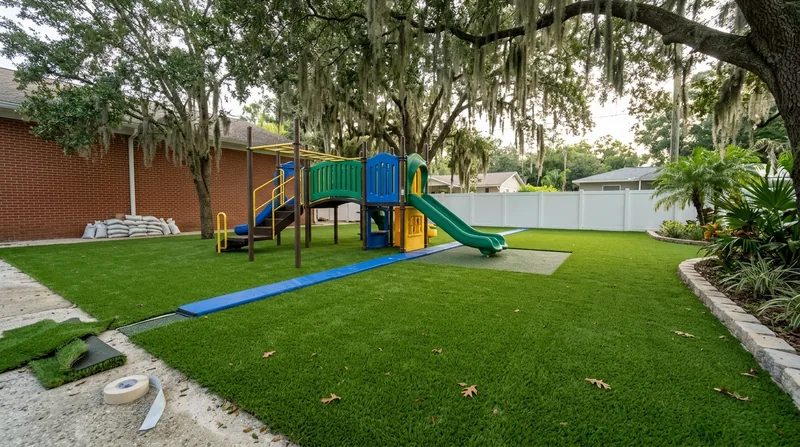




Playground & School Turf in Orlando keeps children safe, drains fast after Central Florida's daily summer thunderstorms, and stays cleaner than wood chips or mulch. Private schools, daycares, churches, and community parks across Orlando, Winter Park, Windermere, and Apopka face the same challenge: equipment fall zones need padding, drainage, and a surface that handles heat, humidity, and heavy foot traffic without rotting or breeding mold. We install safety-rated synthetic turf with engineered infill systems that absorb impact, shed water within hours, and outlast organic materials in Florida's wet subtropical climate. Our work starts with a site assessment of fall heights, drainage patterns, and local building codes, then moves to base preparation, layout, and turf installation tailored to the school or park's specific equipment and use. Whether you manage a daycare playground in downtown Orlando or a community center in Lake Mary, we handle the full scope so your facility reopens safely and on time.
Why Playground & School Turf Matters in Orlando's Heat and Humidity
Central Florida's subtropical climate and sandy soil create conditions that expose the weaknesses of traditional playground surfacing. Mulch and wood chips decompose rapidly in our humid heat, harbor fire ants and mold, and compact under foot traffic, reducing shock absorption. Concrete and asphalt radiate dangerous heat in the afternoon sun and provide no cushioning for falls. Safety-rated synthetic turf addresses all three problems at once: it stays cool, drains standing water in minutes, and maintains consistent padding across the equipment fall zone year-round.
- Engineered infill absorbs impact energy and meets ASTM F1292 fall-height standards for your equipment.
- Open-weave turf lets water drain through to a permeable base, preventing puddles and algae growth in our humid summers.
- Synthetic fibers resist rot, mold, and insect infestation far longer than organic materials in Florida's climate.
- Surface stays at a manageable temperature even in peak afternoon heat, reducing burn risk on bare skin.
- Cleaner than mulch, reducing tracking of debris into buildings and lowering maintenance labor costs.
These advantages make playground turf a practical investment for schools and daycares managing safety liability and upkeep budgets across Orlando and the surrounding communities.
Key info: Florida Department of Education and local school districts often reference ASTM F1292 and ASTM F1487 for playground surface safety. Check with your facility's risk management office or building department before finalizing turf specs. We work within those standards and help coordinate with your permitting process.
For detailed guidance on playground safety standards and fall-height requirements, see the U.S. Consumer Product Safety Commission playground safety guide.
How We Install Playground & School Turf: Step-by-Step Process in Orlando
A proper playground turf installation begins with understanding the equipment layout, fall zones, and drainage challenges specific to your site. We measure fall heights, identify low spots and water pooling areas, and design a base system that supports the turf while shedding water away from buildings and equipment. The process takes 3 to 7 days depending on site size and base prep scope, and we coordinate timing to minimize disruption to school schedules or daycare operations.
- Site assessment: we measure equipment fall heights, document existing drainage patterns, and identify utilities and irrigation lines that must be marked before excavation.
- Base preparation: we remove old surfacing material, grade the site for drainage, compact subgrade, and lay a permeable base layer (typically 4 to 6 inches of recycled asphalt or engineered stone) for water flow and turf stability.
- Turf layout and cutting: we roll out the synthetic turf, align seams to minimize visibility and stress, and cut around equipment posts, walkways, and building foundations with precision.
- Seaming and edge securing: we heat-weld seams for durability, secure perimeter edges with landscape fabric and stakes, and ensure no gaps or lifted corners that create trip hazards.
- Infill installation and compaction: we spread engineered infill (typically polyethylene or rubber granules rated for your fall height) and brush it evenly across the turf pile for consistent cushioning.
- Final inspection and cleanup: we verify drainage, test fall-height compliance with a ASTM-approved impact test if required, and remove all installation debris.
The result is a safe, durable playground surface ready for use within 24 hours of infill installation.
Example: A 2,500-square-foot daycare playground in Winter Park with aging mulch, poor drainage near the building foundation, and equipment requiring 6-foot fall protection took us 5 days from site prep to final infill. The new turf drained standing water within 30 minutes of a thunderstorm, eliminated ant and mold issues, and reduced daily maintenance labor by 70 percent.
For more on how we approach site-specific turf challenges, see our commercial artificial grass installation page, which covers similar drainage and safety requirements for larger facilities.
Playground Turf Installation Methods and Materials
| Installation Approach | Description | Best For |
|---|---|---|
| Full Base Prep with Permeable Stone | Remove old material, grade, compact subgrade, lay 4-6 inches of recycled asphalt or engineered stone base for drainage and turf stability. | New installations, sites with poor drainage or compacted soil, schools and parks with heavy use. |
| Existing Concrete or Asphalt Overlay | Install permeable underlay and turf directly over existing hard surfaces, with perimeter drainage to prevent water pooling. | Retrofits of old playgrounds, tight budgets, sites where excavation is not practical. |
| Heat-Welded Seams with Reinforced Edges | Seams are heat-fused for strength and durability, edges secured with landscape fabric and stakes to prevent lifting under foot traffic. | All playground installations to ensure seam integrity and safety under heavy use. |
| ASTM-Compliant Infill Selection | Choose polyethylene or engineered rubber infill rated for your specific fall height and equipment type, installed to consistent depth for uniform cushioning. | All playgrounds; infill type and depth are determined by fall-height requirements and ASTM standards. |
Each method is chosen based on existing site conditions, fall-height requirements, and budget. We specify the turf product, face weight, pile height, infill type and pounds per square foot, and base depth in writing before any work begins.
Playground & School Turf Cost in Orlando: What to Expect
Playground & School Turf pricing in Orlando depends on site size, existing surface removal, base preparation depth, fall-height requirements, and equipment layout. Most installations start at $10 to $15 per square foot for base prep and turf installation with standard infill, but sites with drainage problems, equipment removal, or complex layouts can run higher. A 2,500-square-foot daycare playground typically ranges from $25,000 to $40,000 depending on base work and infill type. A small church play area of 800 square feet might cost $8,000 to $12,000.
The primary cost drivers are base preparation (removing old mulch or concrete, grading, and laying a permeable stone foundation), infill type and depth (engineered to meet fall-height standards), and site complexity (equipment posts, building drainage, accessibility ramps). Schools in Winter Park, Windermere, and downtown Orlando often face similar costs, though sites with poor drainage or shallow soil over rock may require extra base work. We always measure the site, calculate infill volume, and provide a written estimate before starting. Getting 2 to 3 estimates from different installers is smart; compare the turf product specs, infill type and pounds per square foot, base depth and compaction method, and workmanship warranty in writing.
See our full pricing overview for additional context on how we estimate playground and school turf projects.
Playground & School Turf Near Me: What to Look for When Hiring a Turf Installation Company
Playground safety is non-negotiable, so choosing the right turf installer matters. A reputable company will provide a certificate of insurance naming general liability and workers' compensation, a written spec listing the turf product, face weight, pile height, infill type and pounds per square foot, and base depth, references from completed school or daycare projects, and photos of finished work. Ask about their experience with ASTM F1292 and F1487 standards, and whether they coordinate with local building departments on permits and inspections. Many schools require proof of insurance and a signed contract with performance guarantees before work starts.
- Request a certificate of insurance showing general liability and workers' compensation coverage before signing any contract.
- Ask for a written spec that names the turf product, face weight in ounces per square yard, pile height in millimeters, infill type and pounds per square foot, and base depth and compaction method.
- Get references from at least two completed school or daycare playground projects and ask about drainage performance and maintenance costs since installation.
- Verify the installer understands ASTM F1292 fall-height compliance and can coordinate with your local building department on any required inspections or permits.
- Confirm the warranty covers workmanship (typically 1 to 3 years) and ask what happens if seams separate or infill settles unevenly within that period.
- Request photos of finished work showing seams, edge details, and how the turf looks after a year of use to assess durability and aging.
A local, independent turf installation company that names its products and materials in writing, stands behind its work, and understands Orlando's drainage challenges is your best protection against poor work and liability exposure.
Ready to get started? Contact us for a free estimate. We'll assess your playground layout, fall-height requirements, and drainage needs, then provide a written quote within 24 hours.
Playground & School Turf in Orlando: Pricing Guide
| Service | Price | Details |
|---|---|---|
| Small playground (400-800 sq ft) | Starting at $10/sq ft | Includes base prep, turf, and standard infill; total typically $4,000 to $8,000 depending on site conditions and equipment layout |
| Medium daycare or school playground (800-2,500 sq ft) | Starting at $12/sq ft | Includes excavation, permeable base, turf installation, heat-welded seams, and ASTM-compliant infill; drainage and fall-height requirements drive final cost |
| Large facility playground (2,500+ sq ft) | Starting at $10/sq ft | Volume pricing applies; includes full base prep, complex equipment layout, multiple fall zones, and custom infill depths for different equipment heights |
| Existing surface removal and disposal | On estimate | Mulch, wood chips, or old turf removal adds $1 to $3 per square foot depending on material type and access for haul-away |
| Site assessment and written estimate | Free | We measure fall heights, document drainage patterns, identify utilities, and provide a detailed written quote with product specs within 24 hours |
Indicative pricing, the exact cost depends on square footage, finish, and site access. Free personalized estimate within 24h at (407) 974-5418.


